
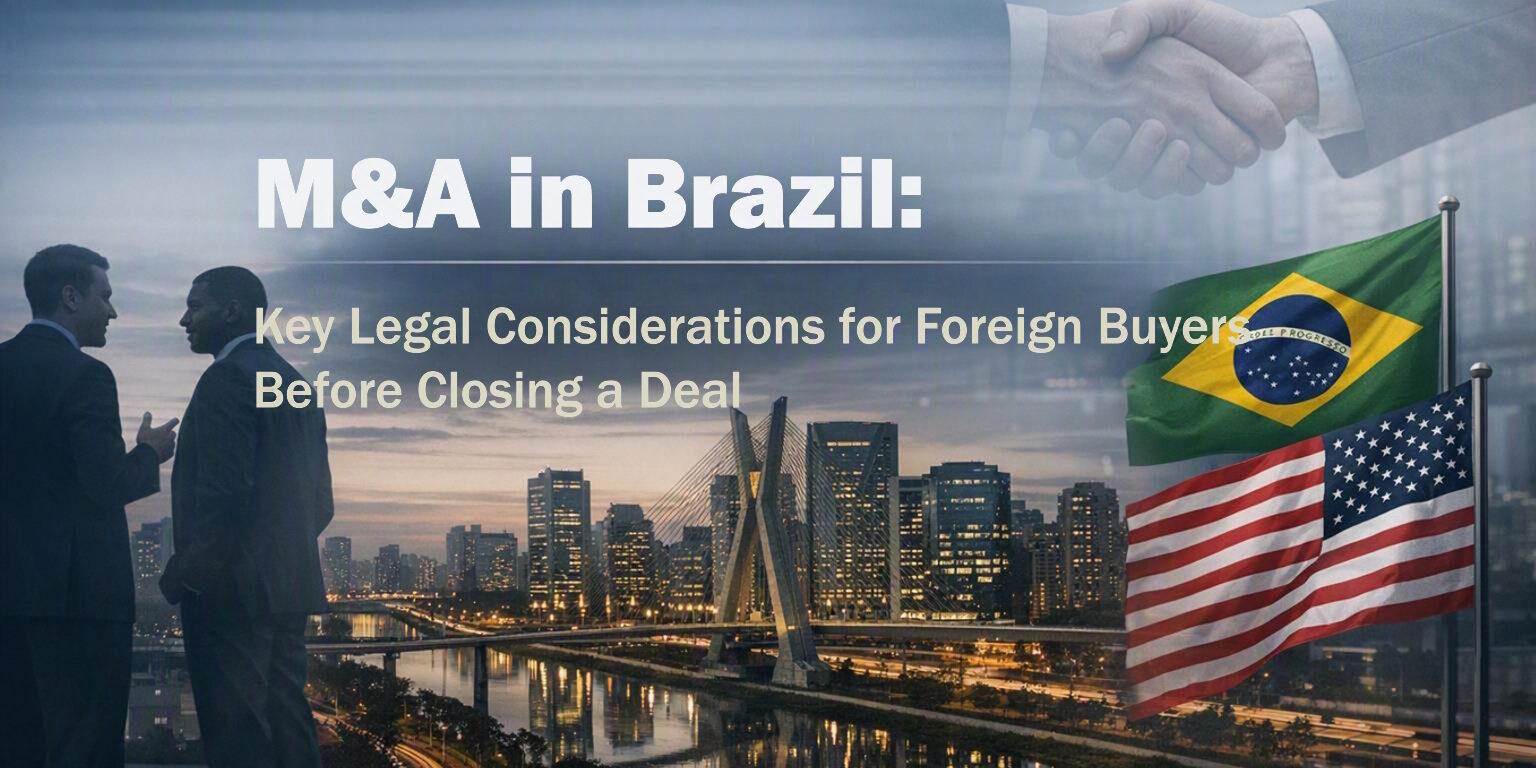
- Brazil as an M&A Destination: Opportunity and Structural Complexity
Brazil continues to attract significant attention from foreign investors seeking growth in emerging markets, particularly in sectors such as infrastructure, technology, agribusiness, and energy. The country offers scale, a diversified economy, and compelling valuation opportunities—yet it also carries a well-known reputation for legal and regulatory complexity.
For international buyers, the key challenge is not identifying opportunities, but executing transactions in a way that preserves value after closing. In Brazil, successful acquisitions are not driven solely by price or financial modeling. They depend heavily on legal structuring, risk allocation, and the ability to anticipate local liabilities that are often underestimated.
The difference between a successful investment and an underperforming one frequently lies in what is negotiated – and understood – before signing.
- Deal Structuring: Share Deal vs Asset Deal
The choice between acquiring shares or assets is one of the first – and most consequential – decisions in a Brazilian transaction.
A share deal typically allows for a cleaner operational transition. The target continues to operate with its existing contracts, licenses, and workforce. However, this structure also results in full legal succession, meaning the buyer inherits all historical liabilities—whether or not they are identified during due diligence.
An asset deal, on the other hand, enables the buyer to ring-fence specific liabilities by selecting which assets to acquire. In practice, however, Brazilian law limits this protection significantly, particularly in labor, tax, and environmental matters, where courts may impose successor liability based on the continuity of business activity.
From a tax perspective, the distinction is equally critical. Asset deals may trigger immediate taxation at the seller level, while share deals can, under certain circumstances, be structured more efficiently.
Strategic insight: In Brazil, the perceived “cleanliness” of an asset deal can be misleading. Courts and regulators often prioritize substance over form. Structuring decisions must be grounded in enforceability, not theory.
- Due Diligence: Where Risks Actually Lie
Foreign investors frequently approach Brazilian due diligence with a global checklist mindset. This is insufficient.
The most material risks in Brazil tend to arise in areas where legal exposure accumulates over time and is not always fully reflected in financial statements.
Labor liabilities are a prime example. Brazilian labor courts are traditionally employee-friendly, and claims often involve multiple layers of potential liability, including overtime, benefits misclassification, and outsourced workforce risks. Even compliant companies may face significant exposure due to aggressive litigation practices.
Tax exposure is another critical area. Brazil’s tax system is highly complex, with overlapping federal, state, and municipal regimes. Disputes are common, and many companies operate with ongoing tax contingencies that may take years to resolve.
Regulatory risks vary by sector but can include licensing irregularities, non-compliance with industry-specific rules, or exposure to administrative penalties. These issues often arise not from intentional misconduct, but from fragmented compliance practices over time.
Environmental liabilities deserve particular attention, especially in industrial or real estate-intensive businesses. Brazilian law imposes strict, and often joint, liability for environmental damage, which may extend to the buyer regardless of fault.
Strategic insight: In Brazil, the most relevant risks are rarely found in headline issues. They are embedded in operational practices and legacy structures. Effective due diligence requires local judgment, not just documentation review.
- Representations & Warranties in Brazil
Standard international representations and warranties frameworks are often inadequate when applied directly in Brazilian transactions.
While global templates provide a useful starting point, they must be carefully adapted to reflect local legal realities. This includes expanding the scope of representations in areas such as labor compliance, tax regularity, environmental matters, and regulatory licensing.
Survival periods also require careful calibration. In Brazil, certain liabilities – particularly tax and labor – may arise years after closing. Limiting exposure through short survival periods or narrow representations can leave buyers materially unprotected.
Caps and baskets must be aligned with the actual risk profile of the target. Overly aggressive limitations, often pushed by sellers, may undermine the effectiveness of the contractual protection framework.
Strategic insight: Representations and warranties in Brazil should not be treated as a standardized exercise. They are the primary mechanism through which legal risk is translated into economic protection.
- Indemnities and Protection Mechanisms
Indemnity structures are essential in Brazilian M&A, but their effectiveness depends on enforceability.
Escrow accounts and price retention mechanisms are widely used to secure indemnity obligations. These tools provide immediate access to funds in the event of a claim, mitigating the need for lengthy legal proceedings.
However, enforcement in Brazil can be time-consuming, particularly if disputes escalate to litigation or arbitration. Buyers should not rely solely on contractual rights without corresponding financial safeguards.
Specific indemnities are often used to address identified risks, such as ongoing tax disputes or known labor contingencies. These indemnities should be clearly drafted, with objective triggers and defined compensation mechanisms.
Strategic insight: In Brazil, an indemnity without security is often insufficient. The real protection lies in combining robust contractual language with practical enforceability mechanisms.
- Payment Structure and FX Considerations
Cross-border transactions involving Brazil require careful attention to foreign exchange regulations and Central Bank reporting requirements.
Payments must comply with Brazilian foreign exchange rules, including proper registration of inbound investments and adherence to documentation requirements. Failure to comply can create operational and repatriation issues.
Currency volatility is another critical factor. Structuring the purchase price, including potential adjustments or earn-outs, requires careful consideration of exchange rate risk.
Strategic insight: Payment structuring in Brazil is not merely an operational detail. It is a regulatory and financial risk management exercise that must be addressed early in the transaction.
- Post-Closing Governance Risks
Many foreign investors underestimate governance risks after closing, particularly when acquiring minority stakes or partnering with local founders.
Brazilian corporate law offers flexibility, but governance structures must be clearly defined through shareholder agreements. Key matters include decision-making processes, veto rights, board composition, and information rights.
Without robust governance mechanisms, buyers may face limited control over strategic decisions, even after significant capital deployment.
Strategic insight: Value is often lost not at closing, but in the months that follow. Governance is where the investment thesis is either executed—or compromised.
- Founder Retention and Human Risk
In Brazil, founders and key executives play a critical role in business continuity, particularly in founder-led companies.
Retaining these individuals post-closing is often essential, but alignment is not automatic. Cultural differences, changes in control, and shifts in incentives can create friction.
Incentive structures—such as earn-outs, retention bonuses, and equity participation—must be carefully designed to ensure alignment without creating unintended conflicts.
Strategic insight: Human risk is often overlooked in legal structuring, yet it can be one of the most decisive factors in transaction success.
- Compliance and Anti-Corruption
Brazil has a well-developed anti-corruption legal framework, including strict liability for companies involved in corrupt practices.
Foreign investors are particularly exposed to reputational and legal risks in this area, especially when acquiring businesses with historically weak compliance structures.
Due diligence should include a thorough assessment of compliance programs, third-party relationships, and past conduct. Post-closing integration should prioritize the implementation of robust compliance systems.
Strategic insight: Compliance is not a box-checking exercise. It is a fundamental component of risk valuation in Brazilian transactions.
- Common Mistakes Made by Foreign Investors
- Conducting superficial due diligence based on international checklists
- Underestimating the scale and persistence of labor liabilities
- Relying on global transaction templates without local adaptation
- Negotiating weak indemnity and protection structures
- Failing to implement robust post-closing governance mechanisms
- Conclusion
Brazil offers compelling opportunities for foreign investors willing to navigate its complexity with discipline and strategic insight.
The legal risks are real, but they are manageable – with the right approach. The key lies in understanding that Brazilian transactions require more than technical compliance. They demand a proactive, locally informed strategy that integrates legal structuring, risk mitigation, and business execution.
Ultimately, success in Brazilian M&A is not about avoiding risk altogether – it is about identifying, pricing, and controlling it effectively.
And in that context, one conclusion stands out clearly: having the right local legal advisor is critical.





 Fale conosco!